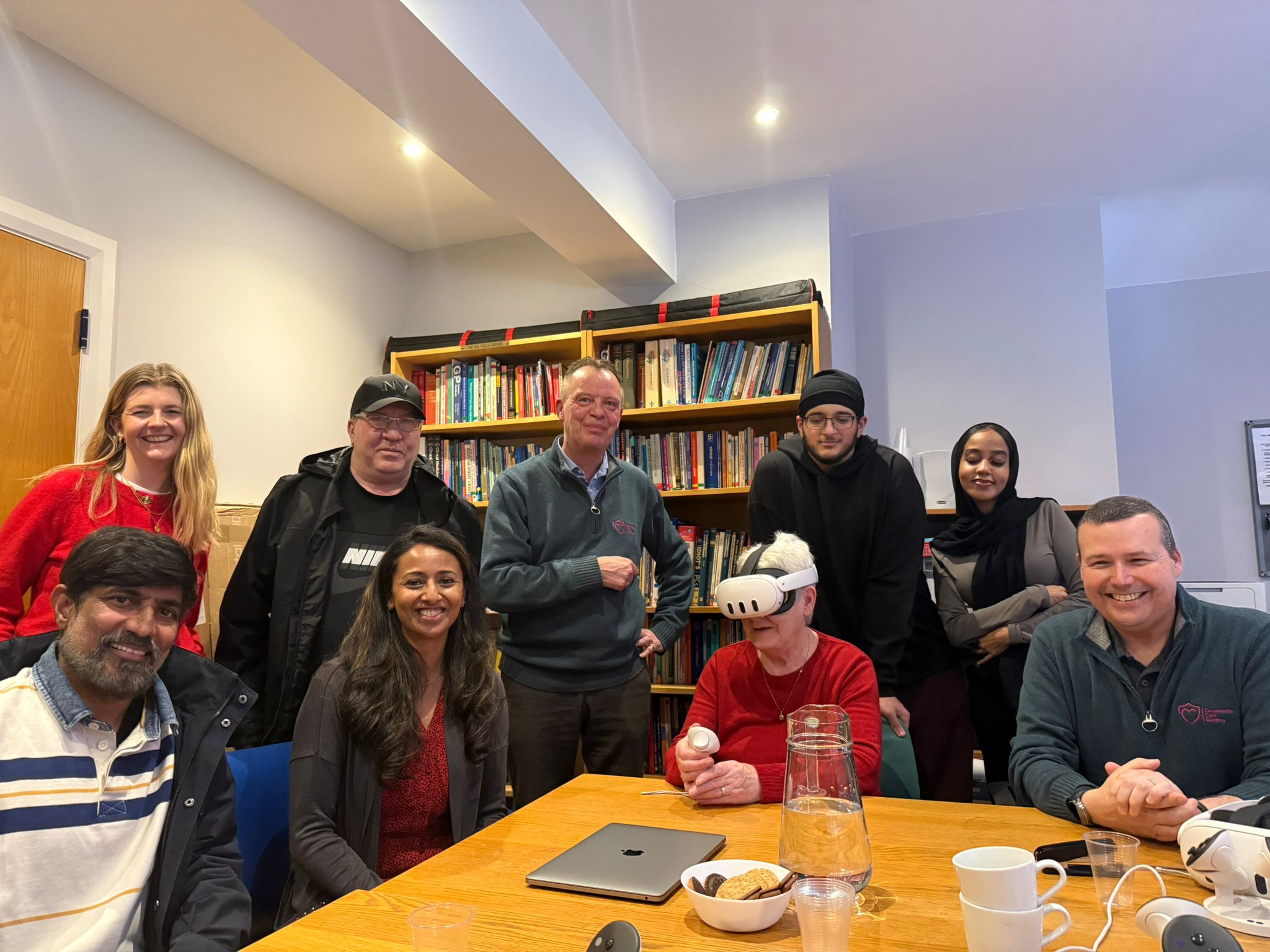
The Community Care Gaming team had the good fortune to meet Doctor
Dhanusha Dharmarajah at the Giant Health tech conference in London back in
December 2025. She and her colleague showed an acute interest in our virtual
reality healthcare project, as we demonstrated both the concept and the
implementation of the programme through our immersive software and Virtual
Reality headsets. We continued to communicate with Dr Dharmarajah over the next
few weeks and it became clear that her interest was more than simply academic.
After a series of emails and calls we established that the Community Care Gaming
team would travel to Wembley to work with her medical practice the law medical
practice, the Law Medical Group Practice, and also to work with their partner BUPA
care home in Wembley. John Dabill and Adrian Sladdin travelled north in
February with 10 headsets and all the necessary support technology in order to
deliver training. Dr Dharmarajah, her team and medical students all gathered at
the Bupa care home to demonstrate the product both to the members of staff at the
medical practice but also to managers and staff at the BUPA care home. As ever
this was an effective display of how modern technology can enrich lives,
including patients at the medical practice and residents of the care home.
At Community Care Gaming our immersive experience through
the technology of virtual reality allows us to address such health issues as
the onset of dementia stroke rehabilitation mental health and well-being social
isolation and even happiness. Demonstrating the technology is always a delight;
few can resist the pleasure and enjoyment of escaping into THE DOMES, a virtual
environment created by Community Care Gaming which allows you says to be
immersed in a welcoming environment, a nostalgic zone, a learning and education
area, and a health and well-being dome amongst others. Alongside we provide
access to 360° video experiences. These can range from hot air ballooning to
watching big cats in the Serengeti to driving a Formula 1 car. Users can go
back in time, they can travel the globe, they can fulfil their lifetime goals
and ambitions or even find new ones. Our demonstration at the home was a
notable success with all those we trained finding not only the benefits of the
programme personally but recognising how this would transfer onto those in the
over 50 demographic.
In the afternoon we walked 5 minutes back from the care home
to the medical practice where five patients on register had volunteered to be ‘guinea
pigs’ in trialling the VR headsets in the practice. Tom, Ian, Mary, Conrad and
Mieta, all of a certain age, were happy to embrace the technology, albeit
somewhat reluctantly, but by the end of the hour session all of them agreed
that this was a remarkable thing indeed. They chose a range of differing
activities, all exploring the possibilities of the Dome, taking control of not
just the headsets but the handsets in order to manoeuvre around those areas.
They then selected options from the
videos which interested them, allowing them a personalised and bespoke
experience. Feedback from everyone was that this was an amazing thing and that
they would be very happy to return in a few weeks to see whether they could
perceive an improvement through using virtual reality.
John and Adrian will go back north very soon to work with
residents of the care home as well as the medical practice patients directly;
they will also be employing the services of the newly trained doctors and
students from the law medical practice.
All in all it shows how a brief conversation at a conference
can turn into a concrete experience yielding many benefits great feedback and
so many possibilities for the future.
Find out more about our ground-breaking work at hello@communitycaregaming.org